 Senti
Senti
Industries / Forex VPS, Hosting & Algo-Trading Infrastructure Providers
Sell more than the machine.
Senti's automation layer, installed on your fleet and delivered from your admin system under your brand. Your infrastructure, customers, and billing stay yours.
These figures show platform activity and availability. They are not investment performance or return claims.
Not a competitor. The software layer above your compute.
Senti does not replace VPS hosting. MT5 strictly requires a Windows terminal on dedicated server compute, that operational reality remains identical whether on Senti’s infrastructure or your own server fleet. Senti abstracts the operations above the metal.
Instead of forcing end users to manually install terminals, configure .ex5 files, and babysit connections via clunky RDP sessions, Senti provides a unified browser-based operating layer.
- Your infrastructure remains yours: You operate the servers, own the client billing, and maintain complete hardware control.
- Senti powers the software layer: We eliminate manual terminal maintenance, turning raw compute into an intelligent, managed trading service.
Your product stops at the machine. The customer’s pain starts above it.
Hosting providers deliver server uptime competently. But the recurring support load stems from the unmanaged software layer above the operating system.
- Manual Customer Onboarding: Clients struggle with MT5 installations, .ex5 bindings, and manual reconnects after every reboot.
- Friction of Remote Desktop: Diagnosing routine bot health forces users through clunky RDP credentials, virtually impossible on mobile devices.
- Silent Terminal Crashes: A dropped MT5 connection or frozen EA goes unnoticed until the user discovers missed trades and files an angry ticket.
- Support Drained by Status Checks: Over 80% of support tickets are “is my bot running?” questions, wasting engineering time on non-fault queries.
- Commoditized Hardware Margins: Raw specs, locations, and pricing look identical across vendors, locking your business into a margin-compressing price war.
None of this is a server failure. It is the operational gap between “the machine is online” and “the trading bot is executing”.
Turn raw VPS compute into managed automation telemetry
A lightweight, headless agent installed directly onto MT5 instances running across your infrastructure, streaming live state to a branded browser console.
- Terminal Connectivity: Continuous verification that MT5 is running, logged in, and linked to the broker bridge.
- EA Execution State: Real-time detection of active Expert Advisors, algorithmic permissions, and chart attachments.
- Account-Level Telemetry: Instant visibility into equity, balance, open orders, and live drawdown per instance.
- Tamper-Proof Activity Logs: Verifiable timestamped execution history, support conversations start from log facts, not screenshots.
- Governed Remote Controls: Scoped pause, stop, and restart commands enforced via strict role-based permission boundaries.
- Automated Heartbeat Alerts: Instant automated notifications the moment a managed terminal disconnects or freezes.
Your instances keep running the terminals, exactly as they do now. Senti supplies the layer that operates them.
The only two things that change
The operating principle is the same one Senti runs in its own product. A partner conversation goes wrong when this is presented as a different architecture, so be precise about what actually differs.
Two rows move: whose infrastructure it runs on, and whose product it arrives in. Everything else is identical. This is also why Senti Inside is not a migration path onto Senti’s infrastructure. Your fleet keeps running your customers’ terminals, and if a partner conversation needs that written into the agreement, it should be.
A bidirectional distribution channel
You distribute Senti to upsell higher-margin managed tiers. Senti routes underlying compute demand directly to your infrastructure fleet.
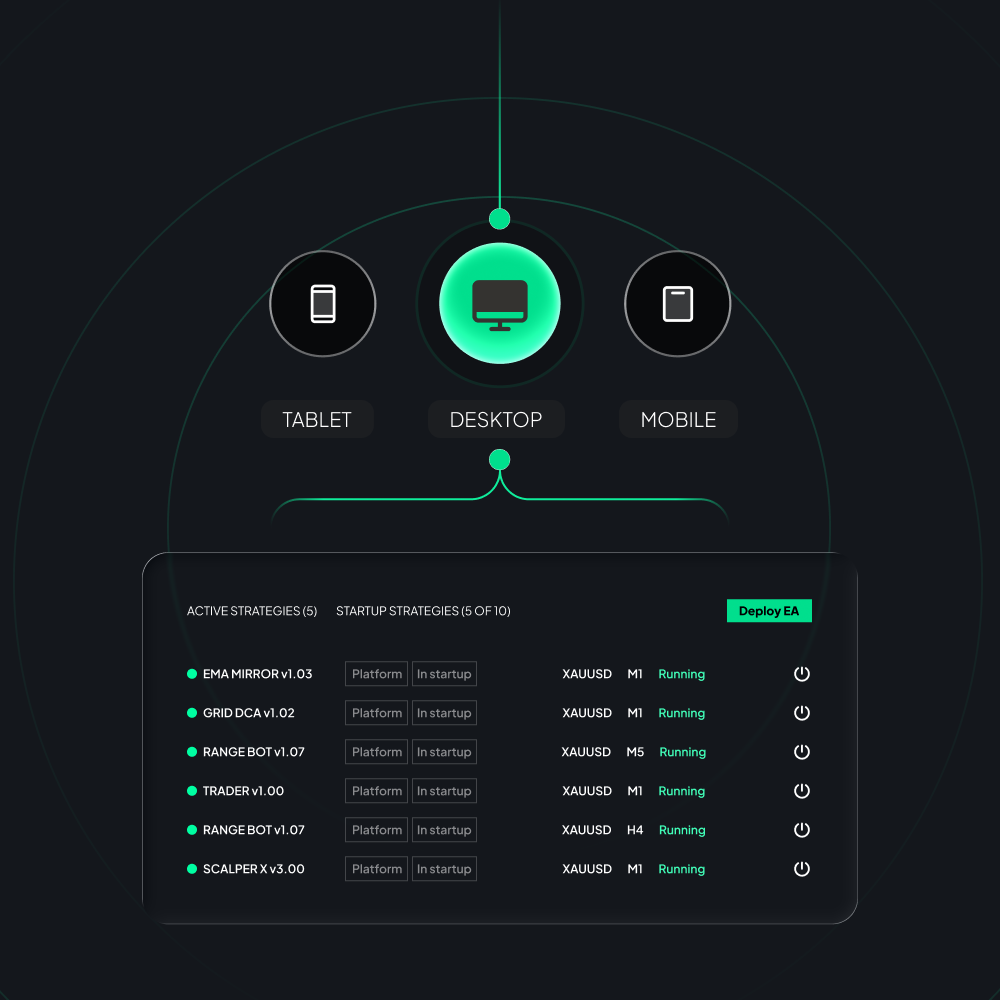
Your brand on the portal. Senti's demand on your fleet.
How the partnership runs in both directions:
- You Distribute Senti: Offer an institutional-grade, browser-based management portal embedded inside your client billing panel. Your users never need to leave your brand.
- Senti Routes Demand to You: Senti’s growing user base requires high-performance VPS compute globally. We route hosting demand to certified partner fleets with zero friction.
Each side is invisible inside the other’s product, which is what makes both directions work at once.
What each side owns
High-margin managed services. Drastically lower support overhead.
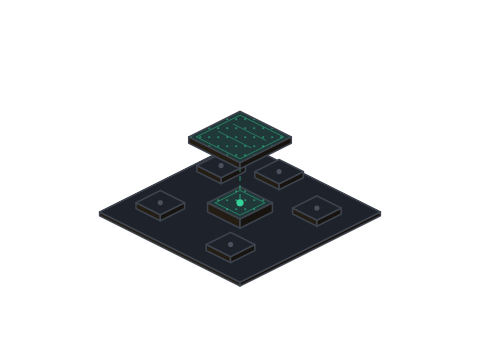
- Ascend Above Raw Compute: Upgrade your offering from commodity server rental to a premium managed trading service.
- Break Free from Price Wars: Sell high-value software capability rather than racing competitors to the bottom on RAM/CPU pricing.
- Deflect Repetitive Support Tickets: Empower users to check terminal health and logs via self-serve dashboards, deflecting routine status inquiries.
- Tangible Sales Differentiator: Give your sales and marketing teams an interactive, browser-based feature to showcase instead of dry latency numbers.
- Proactive Outage Detection: Catch stopped terminals and execution drops long before the customer notices missed trades.
- Mobile-First Client Reach: Enable busy traders to govern execution directly from mobile browsers without remote desktop apps.
Senti Inside provides operational telemetry and automation infrastructure. Senti does not manage customer funds, execute trading decisions, or guarantee market performance.
Technical fit and deployment requirements
Terms of Service Alignment: Deploying an agent onto client instances carries privacy, consent, and data-handling implications that vary by regulatory jurisdiction. We review your existing customer terms during our initial technical discovery call.
No commercial model is confirmed
Senti’s other B2B services bill per Trade Account, because that is where Senti’s compute cost sits. Here your fleet runs the terminals, so that basis doesn’t apply. And if the partnership runs both ways, the question isn’t a unit price. It’s how two partners settle a layer-for-capacity exchange.
This page publishes no rate, no per-terminal price, no revenue share, and no setup fee. The billing shape depends on whether an agreement carries one direction or both, and that is scoped in the partnership conversation rather than quoted from a rate card.
How an engagement would start
Walk through your hosting architecture, instance images, control panel, customer terms, and the support load you want to reduce.
Agree how the agent reaches the terminals: baked into your instance image, deployed through your existing management tooling, or installed per customer on activation.
Settle the data scope, permission model, supported control actions, authentication, branding, and the support handoff between your desk and Senti’s escalation path.
Run the addon on a small, named set of instances with agreed acceptance criteria before it reaches the general customer base.
Decide which plans include it, how it is presented to customers, and what your support team is trained to answer.
Extend to the wider instance population once the operational model holds.
Timelines depend on your instance management, panel architecture, and terms review. They are confirmed after the technical review rather than promised in advance.
Frequently asked questions
Does this move our customers onto Senti’s infrastructure? +
Is Senti not a competitor to VPS providers? +
What can a customer actually do from the surface? +
Does Senti see our customers’ strategies? +
Bring your fleet. Leave with a scope.
Bring your architecture, control panel, customer terms, and the tickets you would most like to stop answering. We will scope the layer and name the open questions.